Do-calculus for Humans
The do-operator sits at the heart of Pearl’s causal inference framework. At first glance, the notation seems like nothing more than jargon for something easy to understand. You draw a DAG, find the backdoor paths, and adjust for those variables. Isn’t this just a fancy way of saying “control for confounders”?
Sort of. For simple problems, the do-operator is just notation for controlling for confounders. But it can be useful when confounders can’t be measured, because the do-calculus can tell you whether a causal effect is still identifiable. Whether that matters in practice depends on how much you trust your DAG. This post works through a concrete example to show what the do-operator does, where it goes beyond the basics, and when it can be useful.
Seeing Is Not Doing
Suppose a university wants to know whether taking a prep course improves scores on the SAT. They’ve assembled a dataset on about 10,000 students to try to answer this question. Here is what the (fake) sample looks like.
| No Prep | Prep | Overall | |
|---|---|---|---|
| Students | 6,929 | 3,558 | 10,487 |
| Female (%) | 51% | 54% | 52% |
| SAT Score | 1,021 | 1,159 | 1,068 |
| Family Income (k) | 71k | 85k | 76k |
| Hours Studied | 9.5 | 22.0 | 13.7 |
| GPA | 3.45 | 3.59 | 3.50 |
Students who took a prep course scored 138 points higher on average. But students who take a prep course are different from those who don’t. They come from wealthier families, are more academically motivated, and have stronger academic records. The 138-point gap reflects the prep course plus all the other ways prep-takers were going to outscore non-takers anyway.
A DAG makes the contamination visible.
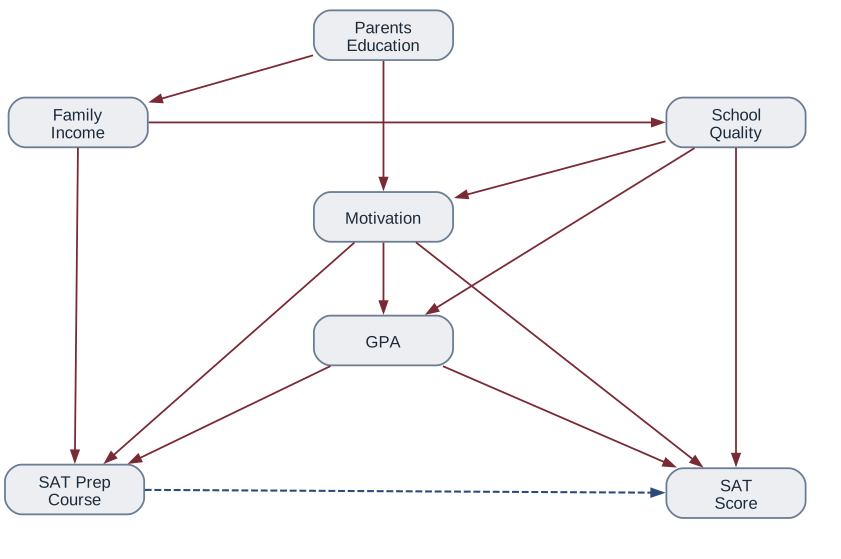
The arrows encode how background factors feed into both the decision to take prep and SAT performance directly.
In notation, the naive comparison is expressed:
.
This conditions on who chose prep, and by doing so, it also conditions on all the factors that influenced that choice. These are the backdoor paths, and they inflate the estimate.
The causal question requires a different condition:
.
The means we’re not looking at who chose prep. We’re asking what would happen if we assigned students to prep (or not), the way a randomized experiment would. Forcing prep to take the value of 1 or 0 neutralizes all the reasons students select into the course. This counterfactual situation doesn’t exist in the data. The do-operator just lets us pretend that it does.
To apply the operator we perform graph surgery by deleting every arrow pointing into the Prep Course node. In a randomized experiment, nothing about a student’s background determines whether they take prep. The incoming arrows represent those background causes, and deleting them is the graphical way of saying these variables are irrelevant.
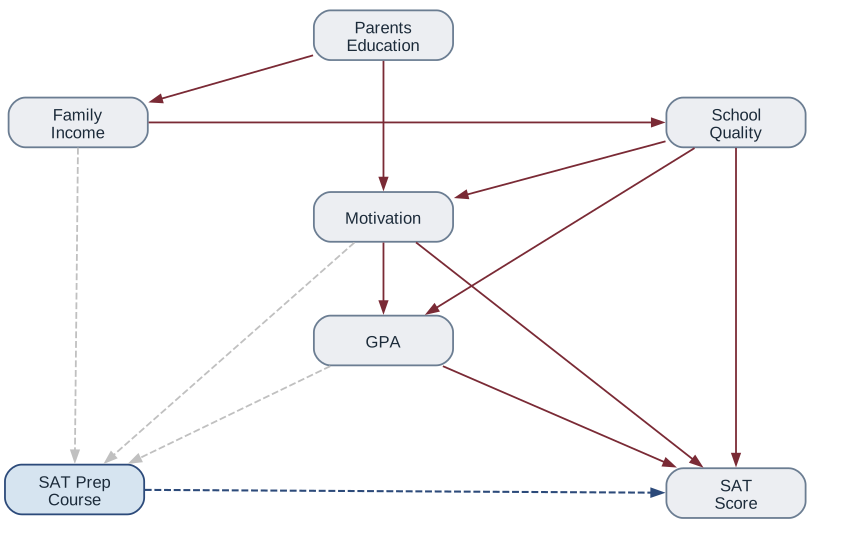
In the updated graph, Prep Course sits alone with no parents. The confounders haven’t disappeared, but they’re influence on prep has. Any remaining association between Prep and SAT Score flows through the causal arrow. That’s exactly the quantity represents.
The Adjustment Formula
We can only delete the paths in theory. We didn’t run an experiment. But under the right conditions, we can use the data to compute what an experiment would have shown.
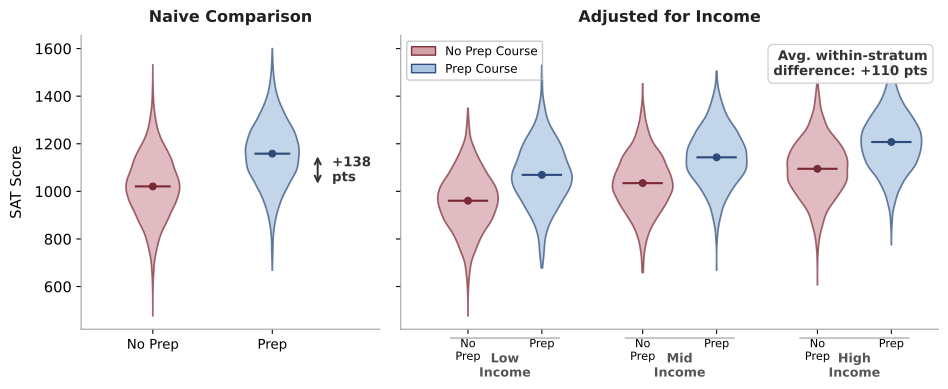
The most common approach is backdoor adjustment. Instead of comparing all prep-takers to non-takers, compare them within groups that share the same background. Using income as an example, you compute effect of prep within each level (low, middle, high) and average those effects together, weighted by each group’s share of the sample. The confounding from income washes out.
The Backdoor Adjustment Formula
Calculate the treatment effect among people with the same confounder values (), then average across all confounder values weighted by how common they are in the sample. must block all backdoor paths from to and must not include anything caused by the treatment.
The weighting by is what separates this from a simple subgroup analysis. Without it, the confounder profiles most common among the treated group would be over-represented, reintroducing the selection bias you’re trying to eliminate. The population weights put everyone on equal footing.
Here’s what the adjustment looks like when we stratify by income group.
| Income Group | Share of Population | Prep Tx Effect | Weighted |
|---|---|---|---|
| Low (< 65k) | 33.3% | +109 pts | 36 |
| Middle (65k–87k) | 33.4% | +108 pts | 36 |
| High (> 87k) | 33.3% | +113 pts | 37 |
| Adjusted estimate | +110 pts |
The new estimate is 110 points. We’ve reduced the bias, but we’re still way off. Income alone doesn’t capture the confounding through motivation and GPA.
Regression Works Too
The adjustment formula is just stratification by another name. You can also accomplish backdoor adjustment by adding the confounders to a regression of Y on X.
With no controls, a regression of SAT on Prep gives us exactly the naive comparison:
Add income as a control and the coefficient on Prep drops:
Add GPA and it drops to 74. And if we could somehow measure motivation and include it too:
| Model | Controls | Prep Coefficient |
|---|---|---|
| Naive | None | +138 pts |
| + Income | Income | +102 pts |
| + Income, GPA | Income, GPA | +74 pts |
| + Motivation | Income, GPA, Motivation | +56 pts |
As we add controls, the coefficient for SAT prep approaches the true effect of 55 points. The last model is hypothetical, since motivation is unmeasured. That gap between 74 and 56 is the bias from the unmeasured confounder.
The adjustment formula, graph surgery, and regression are all doing the same thing. The graph surgery tells you what confounding to remove. The formula tells you which variables accomplish that removal. Regression does the removing.
The -operator is the notation that connects all three. The critical observation is that is NOT the same as . To see why, look at what actually computes. When we calculate , the people contributing to that value are disproportionately wealthy, motivated, and high-GPA, because those are the people who chose to do prep. The average is tilted toward students who would have scored well regardless. That’s why the naive estimate is 138 points.
asks a different question: what if everyone were assigned to prep, regardless of background? The adjustment formula accomplishes this by reweighting. Instead of letting the confounder distribution of prep-takers drive the average, it weights each confounder stratum by its share of the overall population. That’s what the term does. If you adjust for every confounder, the estimate will drop from 138 to something close to the true effect of 55.
When the Backdoor Fails
Up to this point, the do-operator hasn’t told us anything beyond the backdoor criterion alone. The do-calculus becomes useful when the backdoor criterion fails. To fully block the backdoor paths, we need to adjust for academic motivation. But motivation isn’t in our dataset. Since it affects both whether a student takes prep and how well they score, there’s a backdoor path we can’t block.
But remember we have data on how many hours each student studied per week. Prep courses increase study time, and study time improves scores. If the entire causal effect of prep on SAT scores flows through hours studied, which is a very strong assumption, we have a front-door path.
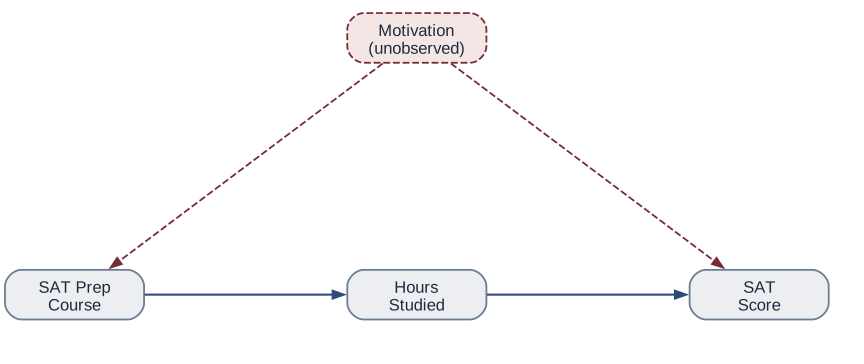
The front-door criterion exploits the fact that Hours Studied sits between Prep and SAT. That position lets us attack the problem from both sides.
Piece one: the effect of Prep on Hours Studied. Motivation makes some students more likely to take prep, and motivation also makes them study more. But in this DAG, motivation only reaches hours studied through the Prep Course node. So the observed relationship between prep and hours is unconfounded. Students who take the course study about 11 more hours on average. No adjustment needed.
Piece two: the effect of Hours Studied on SAT Score. This one is trickier. Motivation affects SAT scores directly, and it reaches hours studied indirectly through Prep. That creates a backdoor path: Hours ← Prep ← Motivation → SAT. But Prep is on that path, so adjusting for it blocks the confounding. Among students who all took prep (or all didn’t), the variation in hours studied is no longer driven by the choice to take prep. Within those groups, the relationship between hours and SAT scores reflects the causal effect of studying.
Chain the two pieces together. Prep adds about 11 hours of study. Each additional hour adds about 5 SAT points (estimated from piece two). Multiply them and you get roughly 54 points. Far below the naive 138-point gap, and right near the true effect of 55. All without ever measuring motivation.1
The Front-Door Formula
where is the mediator (Hours Studied), is the treatment (Prep Course), and is the outcome (SAT Score). The first sum captures the effect of treatment on the mediator. The second is itself a backdoor adjustment: it estimates by adjusting for , which blocks the backdoor path Hours ← Prep ← Motivation → SAT.
Front-Door in Practice
The front-door formula also reduces to down to two regression models, run in sequence.
Step 1. Regress Hours Studied on Prep Course. No controls needed, because the DAG tells us this relationship is unconfounded:
Prep adds 11 hours of study.
Step 2. Regress SAT Score on Hours Studied, controlling for Prep to block the backdoor path (Hours ← Prep ← Motivation → SAT):
Each additional hour of studying adds 4.9 SAT points.
Multiply the two coefficients and you have the front-door causal estimate: points. Close to the true effect of 55, and nowhere near the naive 138.
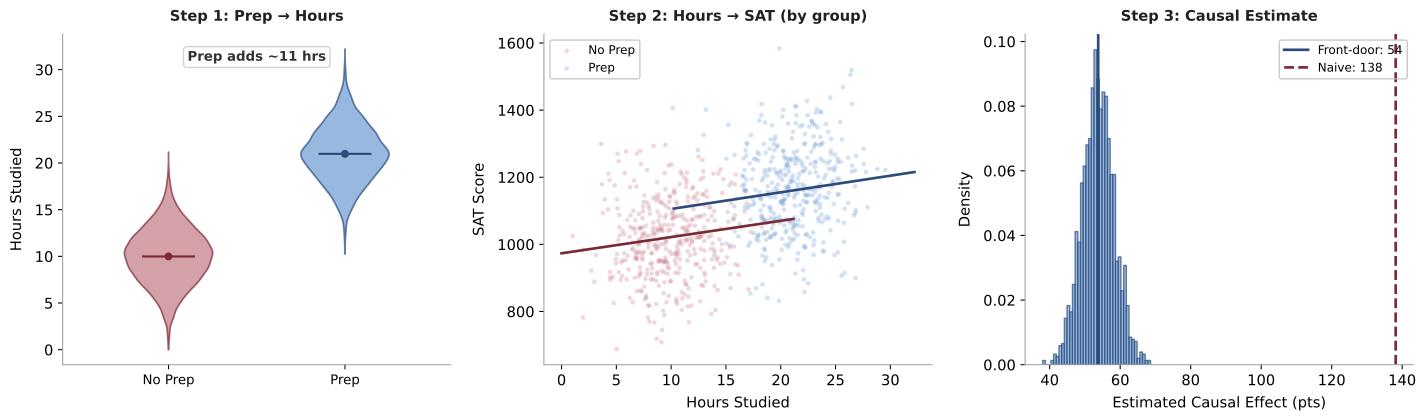
Notice the coefficient on Prep in Step 2 is 84 points. That coefficient absorbs the association between Prep and SAT that runs through the backdoor (Prep ← Motivation → SAT) rather than through Hours. By soaking up that confounding, it frees the Hours coefficient to reflect only the causal effect of studying. This is the same logic the front-door formula encodes, expressed as two fitted models instead of nested summations.
This front-door analysis relies on the strong assumption that motivation affects study hours only through the decision to take prep. This is unlikely true. Motivated students are going to study more regardless of whether they take a prep course. The point is to show the method, not to defend this particular DAG.
Where the Rules Come In
The front-door formula was derived from three rules that together make up the do-calculus. Each rule answers one question: when can you remove from a probability statement. Every represents an intervention we didn’t actually perform. We can’t look up in a dataset the way we can look up . To get an answer from observational data, every has to go. Here’s how the rules derive the front-door result.
We start with what we want: . We can’t compute this directly because of unmeasured motivation. The do-calculus gives us a way to rewrite it in terms of things we can compute.
Step 1. Expand through the mediator. Since the effect of Prep on SAT flows entirely through Hours Studied, we can write
where is Hours Studied. This is the law of total probability applied inside the interventional world.2 We still have operators to eliminate.
Step 2. The effect of Prep on Hours (Rule 2). Look at . In the surgically modified graph (arrows into Prep removed), Prep has no parents, so there can’t be a common cause of Prep and Hours. Observing who took prep gives the same answer as intervening. Rule 2 lets us replace the with ordinary conditioning:
This is piece one. We can estimate it directly from the data.
Step 3. The effect of Hours on SAT (Rules 2 and 3). The term still has an intervention on Prep. We need to get rid of it, but we can’t just drop and observe . Without the intervention, the backdoor path Hours ← Prep ← Motivation → SAT is open, and observing would carry that confounding. We need , not just .
First, Rule 2 converts the observation of into an intervention. In the graph with arrows into Prep removed and arrows out of removed, SAT is independent of given Prep (the only path from to SAT went through the arrow we just cut). So we can replace the observation with an intervention:
Now Rule 3 lets us drop . Once we’ve intervened on Hours, Prep has no other path to SAT (there’s no direct edge), so the intervention on Prep is redundant:
Finally, we need to convert into something observable. The backdoor from Hours to SAT runs through Prep (Hours ← Prep ← Motivation → SAT), and adjusting for Prep blocks it. Rule 2 again converts the intervention into conditioning, with Prep as the adjustment variable:
Every is gone. The entire expression is now estimable from observational data.
Three rules, applied mechanically, derived a formula we couldn’t have gotten from the backdoor criterion alone.
When Does It Matter
If you can measure all the confounders, you don’t need to think about do-calculus. The backdoor criterion handles it. Draw a DAG, identify the adjustment set, run your regression. Most applied causal inference lives here, and the do-operator is just a notation for what you’re already doing.
However, if you can’t measure a key confounder, do-calculus tells you whether you’re stuck. The front-door criterion is one example, but there are others. Instrumental variable setups, mediation-based strategies, and more exotic identification paths all fall out of the same three rules. Without do-calculus, you’d have to discover each strategy separately and hope you haven’t missed one. With it, you have a systematic procedure. If the rules can eliminate all the operators, you have an identification strategy. If they can’t, no amount of statistical sophistication will save you.
The most valuable thing do-calculus provides is the negative case. Knowing that a causal effect cannot be identified from your data, given your assumptions, is arguably more useful than any formula it derives. It stops you from running analyses that look rigorous but aren’t. It tells you when you need better data, a different design, or stronger assumptions.
The Graph Carries the Knowledge
The do-operator is the mathematical notation that makes graph surgery precise. It translates “delete the arrows” into a probability statement, , that you can manipulate with algebra. The do-calculus is the set of rules for that manipulation. If a causal effect can be identified from your DAG and your data, the rules will find the formula. If they can’t, nothing can. Earlier methods could identify some causal effects, but they couldn’t tell you when identification was impossible. The do-calculus settles the question.
But the calculus is only as good as the graph you give it. Draw the wrong DAG, miss a confounder, get an arrow backwards, and the derived formula will be wrong. The rules guarantee logical consistency given your assumptions. They can’t tell you whether your assumptions are right. Many of them probably aren’t. That still requires understanding the domain. The do-calculus carries the logic. The graph carries the knowledge. Neither works without the other.
References
Pearl, J. (1995). Causal diagrams for empirical research. Biometrika, 82(4), 669-688.
Pearl, J. (2012). The do-calculus revisited. Proceedings of the 28th Conference on Uncertainty in Artificial Intelligence (UAI), 3-11.
Glymour, M., Pearl, J., & Jewell, N. P. (2016). Causal Inference in Statistics: A Primer. Wiley.
Huang, Y., & Valtorta, M. (2006). Pearl’s calculus of intervention is complete. Proceedings of the 22nd Conference on Uncertainty in Artificial Intelligence (UAI), 217-224.
Shpitser, I., & Pearl, J. (2006). Identification of joint interventional distributions in recursive semi-Markovian causal models. Proceedings of the 21st National Conference on Artificial Intelligence (AAAI), 1219-1226.
Anyone familiar with mediation analysis will recognize the frontdoor adjustment as nothing more than the indirect effect, , where is the coefficient on the path from to the mediator, and is the coefficient on the path from the mediator to . The indirect effect equals the total effect only when the effect of on is fully mediated. This is a very strong assumption that is almost never true. ↩︎
The law of total probability says you can break any probability into a weighted sum over the values of another variable: . Here we’re doing the same thing, but inside a world where Prep has been set by intervention. We split the effect of Prep on SAT into a sum over all possible values of Hours Studied, weighting each by how likely it is under the intervention. ↩︎